
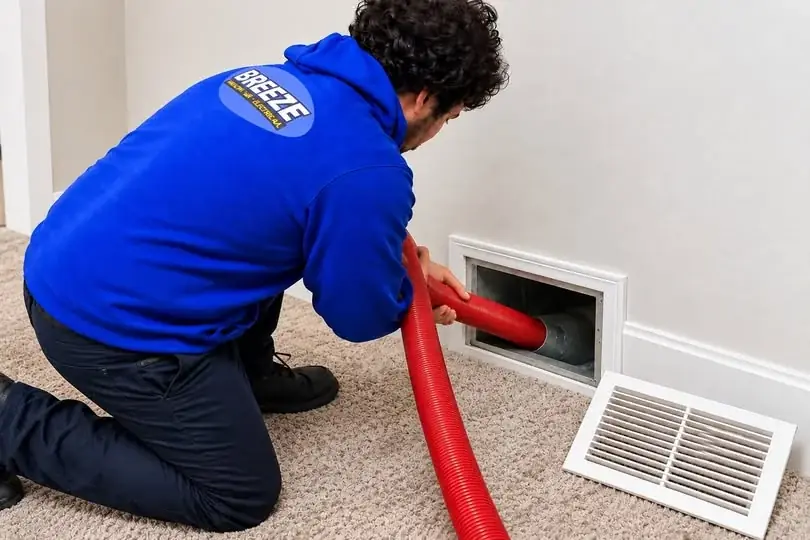
Residential service
Duct cleaning, duct sealing and dry-air comfort.
Breeze’s residential indoor-air services include duct cleaning, Aeroseal duct sealing and whole-home humidifiers. Each addresses a different concern; the right choice depends on your home.
Duct cleaning
Remove accumulated dust and debris from ductwork. Cleaning is a separate service from sealing leaks and does not fix every airflow concern.
Aeroseal duct sealing
Address duct leakage and review what can be measured before and after sealing. It does not replace ventilation, moisture repairs or remediation.
Whole-home humidifiers
Discuss dry air, the existing HVAC system and humidity needs before choosing equipment. Adding humidity is not the right answer to a damp home.
Indoor air quality is not one product or a quick fix. It is how filtration, airflow, ventilation, moisture, ductwork, and everyday activities work together. For Kent, King County, and Eastside homeowners, start with what you notice and when it happens.
Start with what you notice at home
An indoor-air conversation can begin with practical questions:
- Does one room feel stuffy, dusty, or harder to heat and cool than the rest of the house?
- Do cooking or pet odors linger longer than expected?
- Are windows, bathrooms, or closets regularly showing condensation or dampness?
- Does the system seem noisy, weak at certain vents, or unable to move air evenly?
- Are you wondering whether a filter change, a duct concern, or a ventilation issue could be part of the picture?
These signs do not point to one answer. A blocked register, clogged filter, duct leakage, moisture source, or room use can affect the result. Note whether the pattern is seasonal, room-specific, or home-wide.
The building blocks of a practical IAQ plan
Filtration: use the filter your system can handle
A central HVAC filter captures only particles that pass through the system. Filter performance and airflow both matter, so a higher-rated filter is not automatically right for every system. Ask which filter type and replacement interval suit the equipment and filter cabinet. Install it correctly and follow manufacturer instructions.
Portable or whole-home air-cleaning equipment can be another discussion, but it should match the concern. Filtration is generally more useful for particles than gases or odors. Consider the source, space, air movement, and maintenance needs. Ask which options are appropriate and currently available for your home before choosing a product.
Airflow: make sure conditioned air can get where it is needed
Closed or blocked registers, furniture at returns, filter fit, thermostat settings, equipment condition, and duct layout can influence how a room feels. For a room-by-room concern, compare ductwork improvements with Ductless Mini-Splits and Heat Pumps & Electrification.
A heating or cooling concern may also be part of the picture. Explore Heating or Cooling before assuming the issue is solely about indoor air.
Ventilation: bring the right air in and move used air out
Forced-air heating and cooling generally circulate indoor air; they do not necessarily provide outdoor-air ventilation. Kitchen and bathroom exhaust that vents outdoors can help remove moisture, cooking byproducts, and odors at their source. When conditions permit, opening windows can increase outdoor air. If smoke, traffic pollution, or another outdoor source is present, it may not be the right move.
A whole-home ventilation plan should account for the layout, existing exhaust, outdoor conditions, and comfort goals. It is different from simply running the furnace fan.
Moisture: find and correct the water source
Condensation, a musty smell, repeated bathroom dampness, water staining, or a past leak deserves attention. Identify and correct the water source, then dry affected materials. Use bath and kitchen exhaust where appropriate and address plumbing or building-envelope leaks rather than covering up the symptom.
Visible mold, significant water damage, or suspected contamination is not a routine filtration or duct-sealing question. Address the water problem and, when appropriate, consult a qualified remediation or restoration professional rather than relying on an air cleaner to solve the source.
When ductwork deserves a closer look
Ducts carry conditioned air to rooms and return air to the equipment. Leaks, loose connections, damage, kinks, poor insulation, or ducts outside the conditioned part of a home can contribute to uneven temperatures and weak airflow. ENERGY STAR identifies hard-to-condition or stuffy rooms and ducts in unconditioned areas as reasons to investigate duct performance.
A useful duct conversation starts with diagnosis, not a predetermined service. Ask which portions are accessible, whether connection or insulation issues are visible, and whether repair, sealing, balancing, equipment adjustments, or another approach fits the home. Duct cleaning is a separate question, not the default fix for every airflow concern.
Could Aeroseal duct sealing be a fit?
In some homes, an assessment may lead to duct sealing. Accessible leaks may be repaired conventionally; in other situations, an internally applied process such as Aeroseal may be considered. It is one potential tool, not a cure-all for every comfort or air-quality concern.
Before deciding, ask what problem is being measured, which ducts can be addressed, what preparation is needed, and what result can be documented. Visit Aeroseal Duct Sealing to understand the process, then ask whether duct-sealing work is appropriate and currently available for your home.
What a clear next step can look like
- Share the pattern. Note the rooms, seasons, odors, visible moisture, filter history, and airflow changes you have noticed.
- Connect it to the home. Consider the equipment, registers and returns, exhaust, duct access, and moisture sources together.
- Review fit-for-home options. The next step may be maintenance, a filter conversation, ventilation improvements, ductwork investigation, or a related comfort solution.
- Make an informed plan. Request clear scope and product or process details before authorizing work. Review Maintenance Plans or, once confirmed, Financing.
Frequently asked questions
Is a more expensive HVAC filter always better?
No. A filter should balance particle capture with the airflow your equipment and filter cabinet can support. Check manufacturer guidance before changing filter type.
Why does one room feel stuffy when the rest of the house is comfortable?
The cause may involve supply and return airflow, a register or filter restriction, duct layout or leakage, insulation, sun exposure, or room use. Note the room-specific pattern for an assessment.
Can opening windows improve indoor air?
It can increase outdoor-air ventilation when conditions are suitable. If outdoor smoke, traffic pollution, or other contaminants are present, it may not be the right choice.
Does duct sealing replace ventilation or moisture repairs?
No. Duct sealing addresses duct leakage; it does not correct a water leak, provide needed exhaust, or replace a ventilation plan. The right scope depends on the condition being investigated.
Talk through your indoor-air questions
Tell Breeze what you are noticing in your Kent, King County, or Eastside home, whether it is uneven airflow, filter questions, lingering odors, condensation, or concerns about ductwork. We can start the conversation with your home and help identify a practical next step. Contact Breeze to discuss your indoor-air goals.