
Start with your home
If you are worried about a surge damaging your heat pump, appliances or home electronics, it helps to know what protection is practical for your home. Breeze Heating, Air & Electrical provides residential whole-home surge protector diagnosis, repair and installation. We help you understand your options without treating a new device as the answer to every electrical problem. A brief voltage surge can originate outside the home or when electrical loads switch on and off.
The useful question is not simply, “Do I need a surge protector?” It is, “What needs protecting, where can a device be installed correctly, and what electrical conditions should be reviewed first?” A qualified electrician can put those questions in the context of your panel, wiring, grounding, bonding, and priorities.
What “whole-home” protection does, and does not, mean
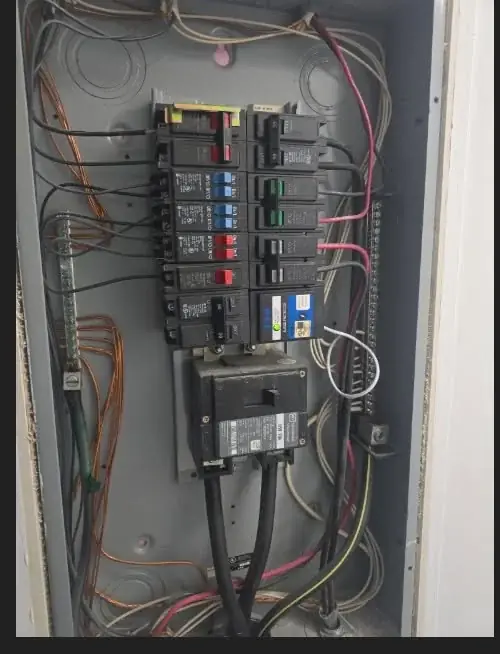
A whole-home setup generally begins with a permanently connected surge protective device (SPD) at or near the service equipment. It limits transient overvoltage along its intended path, making it a first layer for panel-supplied circuits, not the same thing as a plug-in strip beside a television.
The device’s UL type describes its intended application location. A Type 1 SPD may be intended for installation on the line side or load side of the service equipment overcurrent device. A Type 2 SPD is intended for the load side, including at a service or branch panel. The appropriate device and location depend on the equipment listing, the electrical system, and local requirements, not on a label that sounds “stronger.”
Whole-home protection has real limits. It does not correct a wiring fault, replace a breaker, act as a lightning protection system, or make an electrical system immune to damage. It also cannot guarantee protection from a direct lightning strike. Consider it one part of an electrical-risk conversation, not an absolute shield.
Service entrance vs. point-of-use: two different layers
A point-of-use device works close to equipment such as a computer or entertainment system. Under UL application categories, Type 3 SPDs are point-of-utilization devices at the equipment end of a circuit. They may be cord-connected, direct plug-in, or receptacle-type. A plain power strip is not necessarily an SPD, so its labeling matters.
The two approaches can complement one another. The service-entrance device addresses the incoming electrical system; a listed point-of-use protector adds a closer layer for selected electronics, particularly farther from the main panel. Neither layer replaces the other in every situation.
| If your priority is: | A service-entrance SPD can help by: | A point-of-use SPD can help by: |
|---|---|---|
| Broad circuit coverage | Adding a protective layer at the service or panel | Not covering every circuit in the home |
| A specific electronic device | Reducing surge energy reaching the electrical system | Adding protection near that device |
| A long run to sensitive equipment | Providing the first layer | Providing a closer, coordinated layer |
| Absolute protection from all events | It cannot provide this | It cannot provide this |
Selection and installation must suit the system and location and follow manufacturer instructions. Product ratings, enclosure suitability, lead length, and overcurrent protection all matter; an incorrect installation can undermine performance.
Grounding, bonding, and the rest of the electrical picture
An SPD depends on a correctly designed electrical installation; it is not a workaround for unresolved safety concerns. Grounding and bonding are relevant to how current is managed in the system, while breakers serve a different purpose. A breaker is not a substitute for surge protection.
During a proposed assessment, a qualified electrician may review the panel and service configuration, available space, equipment labeling, visible conductors, and accessible grounding and bonding components relevant to the work. The review may identify conditions needing separate attention first. That does not mean every home needs a panel replacement or grounding-system change.
If you notice repeated tripping, warmth or discoloration at electrical equipment, buzzing, burning odor, or damaged enclosures, avoid treating a surge device as the solution. Stop using affected equipment when it is safe to do so and seek qualified electrical evaluation. Do not open a panel or attempt to add a hard-wired SPD yourself.
Questions worth bringing to an assessment
A clear conversation helps distinguish a useful protective layer from a generic add-on. Consider asking:
- Which circuits or equipment matter most to us, and are there subpanels or detached structures to consider?
- Is a service-entrance or panel-mounted SPD compatible with our service equipment and its listed installation options?
- Does the accessible grounding and bonding arrangement call for separate evaluation before installation?
- Are there existing point-of-use protectors, and do their status lights or instructions indicate that replacement is due?
- Could equipment be exposed through connections beyond its power cord, such as communications, cable, or exterior equipment wiring?
- What maintenance or status-indicator checks does the selected manufacturer specify?
These questions help an electrician explain what can be evaluated, what falls outside the proposed scope, and why a recommendation may differ from one home to another.
A simple three-step Breeze process
A useful surge-protection conversation can follow three steps:
- Discuss priorities. Share the equipment you value, any past surge concerns, the location of panels or subpanels, and changes planned for the home.
- Review the electrical setup. A qualified electrician would determine whether an SPD installation can be evaluated at the applicable service or panel location and identify visible conditions relevant to that decision.
- Agree on a scoped next step. Ask about the proposed location, device approach, any prerequisites or separate concerns, and whether Breeze can provide the work before anything is scheduled.
Frequently asked questions
Does a whole-home SPD replace plug-in surge protectors?
No. A service-entrance or panel-mounted SPD is a system-level layer. Listed point-of-use SPDs can still be useful near selected electronics. The right combination depends on the equipment, its location, and the home’s electrical layout.
Is a surge protector the same as a power strip or breaker?
No. A power strip may only add outlets, and a circuit breaker is designed for overcurrent protection. Look for a listed surge protective device when surge protection is the goal, and do not overload any outlet or strip.
Why does grounding matter when adding surge protection?
Grounding and bonding are part of a safe electrical system and are relevant to how an SPD is installed and functions. An electrician can assess accessible, relevant conditions, but an SPD does not repair improper wiring or eliminate the need to address other electrical issues.
Will whole-home surge protection protect against lightning?
It may help limit certain lightning-related surges that reach the electrical system, but no surge device can be promised to handle a direct lightning strike. It should not be represented as total protection for people, a home, or every connected electronic device.
Discuss your electrical priorities
Want to know whether whole-home surge protection makes sense for your home? Call (206) 452-9703 to discuss your concerns and the next step.